Club Med wasn’t alone in using down time during the pandemic to
assess its strategy as an international travel and tourism company.
Other companies in the sector were also hard at work shoring up defences
and planning recovery, even as pandemic revenues plummeted.
New horizons
In 2020, the Paris-founded, now Chinese owned company, received a
€260 million (US$285m) loan, provided largely by the French government,
with support (€80m) from owners Fosun Tourism Group. The loan gave Club
Med the impetus to accelerate its recovery with a raft of development
and marketing initiatives.
The rebound arrived quickly, Club Med’s results in the past year and
first half of this year hastened the process of the loan repayment and
drove significant decisions to pursue development of new resorts and key
digital projects.
New developments have been spread across continents: New resorts
opened in 2021 in the Seychelles, France, China, Canada and Spain.
Another four resorts in France, (two) China and Japan opened in 2022.
Club Med Kiroro Grand opens this month in Hokkaido, Japan, and Club Med Borneo in 2025.
A new identity

Rachael Harding: “For more than 60 years, responsibility and sustainability has been part of the Club Med DNA.”
“Club Med's adaptability and nimble responses, coupled with our
steadfast adherence to key brand pillars and commitment to expansion,
have fortified our position and resilience globally, and especially
within Asia-Pacific,” says Rachael Harding, Club Med chief executive,
East, South Asia, Pacific.
Harding said Club Med “recognised the necessity” for a revitalisation
of its brand not only in Asia Pacific but internationally with the
recent unveiling of the new brand campaign, 'That's l'Esprit Libre.'
“This comprehensive initiative was designed to breathe new life into
the premium holiday lifestyle brand and introduce a new visual identity
to keep our brand fresh and engaging, captivating both new and returning
guests,” Harding added.
The campaign aims to establish 'l'Esprit Libre' (the free spirit) as a
way of life, harking back to Club Med's founding principles over 73
years ago.
“Concrete steps were also taken to align our properties with the
vision of providing liberating and authentic experiences. Renovations
were carried out to enhance guest experience. For example, Club Med
Phuket in Thailand underwent renovations to offer guests a refreshed and
rejuvenated environment,” Harding noted.
Sustainability focus
Club Med has recently turned its attention to Indonesia where at least five resorts are planned.
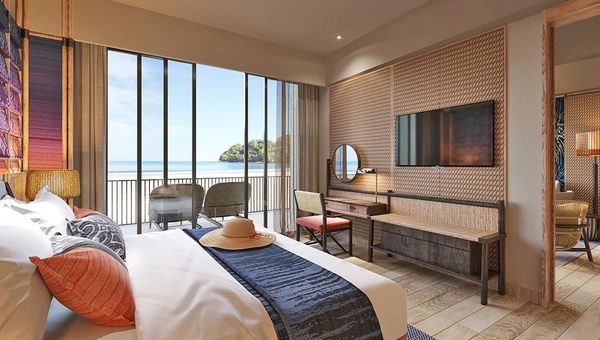
Kota Kinabalu will welcome Club Med’s first large-scale sustainably-built BREEAM-certified beach resort in Asia Pacific.
“Being newbuilds, these resorts present a unique opportunity for us
to create resorts that align with our commitment to sustainability. For
more than 60 years, responsibility and sustainability has been part of
the Club Med DNA,” Harding said.
“’Happy to Care’ is one of our key strategic pillars, aimed to take
care of the environment and communities, with the implementation of
numerous measures in favour of responsible tourism.
“We aim to create spaces where guests can connect with nature,
rejuvenate, and enjoy a sense of freedom, all while leaving a minimal
environmental footprint.”
“Club Med's ‘Happy to Care’ policy constitutes another key pillar of
our strategy, building upon the deep-rooted commitment to caring for
both people and the environment. The integration of ‘Happy To Care’ as a
strategic pillar has not only allowed Club Med to strengthen what the
brand has done for over 60 years, but to also innovate during the
pandemic.
“It underscored our efforts to prioritise the well-being of guests
and team members, while conscientiously developing and implementing
environmentally conscious practices.”