Amara Singapore has completed the first phase of its room
refurbishments, following Amara Hotels & Resorts’ announcement of a
comprehensive brand redesign for its flagship Singapore properties.
Currently, 389 rooms have undergone the redesign; Amara Singapore has
worked with hospitality design firm Studio HBA to draw inspiration from
cultural relics in the hotel’s vicinity, from the traditional hawker
stalls at Tanjong Pagar Plaza, to the conserved shophouses found
throughout the Chinatown Historic District and the heritage trees in the
nearby Duxton Plain Park.
“Amara Singapore has seen immense transformation in the past 38 years
since it was first established in 1986,” said Dawn Teo, senior vice
president of Amara Hotels & Resorts. “Evolving alongside Tanjong
Pagar over the past four decades, we have adopted a design philosophy
that pays homage to the hotel’s culturally rich environs.”
This philosophy extends beyond the guest rooms, with corridors
featuring intricate wallcoverings inspired by the textured alleyways of
neighbouring shophouses, and an overall interplay between wood, earthy
material and green accents drawing from the vicinity’s history and
culture.
Grab-and-go in the lobby
Compared to the quiet
sanctuary of the guest rooms, the newly introduced Lobby Bar exudes a
more vibrant energy that changes with the rhythm of the day, from
natural lighting in the day to a soft glow from the Bar’s lights in the
evening.
The Lobby Bar is also more theatrical in its presentation, with the
solid granite steps that lead to it harkening to the covered walkways
found within the Tanjong Pagar neighbourhood, and the terracotta
elements used in the bar’s backdrop referencing the roofs of the local
shophouses.
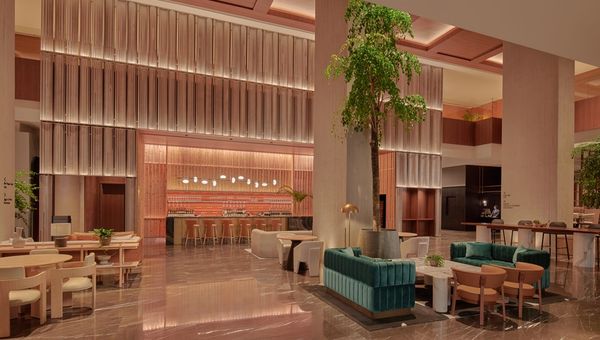
The Lobby Bar pays homage to the heritage of the surrounding Tanjong Pagar neighbourhood, where the hotel first opened in 1986.
Meanwhile, the adjacent Cafe Oriental has now reopened after
undergoing interior refurbishment, using the Tanjong Pagar Plaza Food
Centre as the design anchor for the space.
In a reimagining of the modern-day hawker stall, the café has infused
the space with details from the tiled floor pattern to the
stainless-steel counters commonly found in local hawker stalls.
“Central to our design philosophy was honouring the significance of
Amara Hotel’s rich history within the community – it has and always will
serve as a cornerstone in the heart of the Tanjong Pagar
neighbourhood,” said Joris Angevaare, partner at Studio HBA. “Our aim
was to create a space that embodies comfort and engagement yet also
exudes vitality, highlighted by the interactions between guests and
locals.”