Changi Airport Group’s (CAG) ongoing commitment to diversity and
inclusion has given rise to the launch of a new initiative that will
further ease airport processes for passengers with invisible
disabilities, such as autism spectrum disorder, anxiety, Down Syndrome
and dementia.
Given that travelling in the Covid-19 era comes with an intricate web
of rules that even seasoned travellers may find challenging to handle,
Damon Wong, vice president of CAG’s passenger experience, ground
operations and customer service believes that “navigating unfamiliar
places and procedures while catching a flight can be stressful,
especially for passengers whose disabilities may not be immediately
apparent.”
Under this new assisted service, CAG has introduced an airport guide
that visually guides passengers through the various travel procedures;
special lanyards for them to be easily identified by airport staff; and
staff specially trained to recognise and assist passengers with mental
health issues and/or learning disabilities.
“We worked closely with experts and sought feedback from the
community on how we could better support their needs at the airport,”
Wong said. “The initiatives aim to improve the overall travel experience
for passengers with invisible disabilities and we hope it makes the
airport a more comfortable and accessible place for them.”
Visual guide for passengers with autism
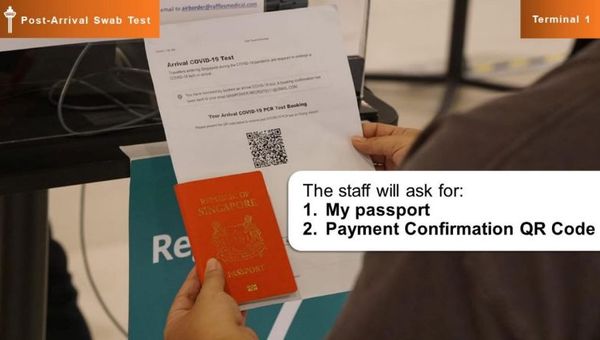
The step-by-step guide allows passengers to familiarise themselves with the full flight experience. Photo Credit: Changi Airport Group
The Changi Airport Social Story is a comprehensive guide with visual
aids that outlines each step of the flight departure and arrival
process, including prevailing guidelines on health and safety protocols
in light of Covid-19.
Created in collaboration with Rainbow Centre Training Consultancy
(RCTC), this step-by-step guide allows for the personalisation of each
individual passenger’s journey. It provides detailed visualisation and
instructions for every step of a passenger’s airport experience that
include using the self-check-in kiosk, standing on stickers that denote a
1m safe distance, walking to the boarding gate, providing confirmation
of the Covid-19 PCR test booking and more.
The guide can be downloaded on Changi Airport’s website can serve as pre-flight preparation to ease any anxiety with travelling.
Lanyard identifiers that indicate the need for assistance
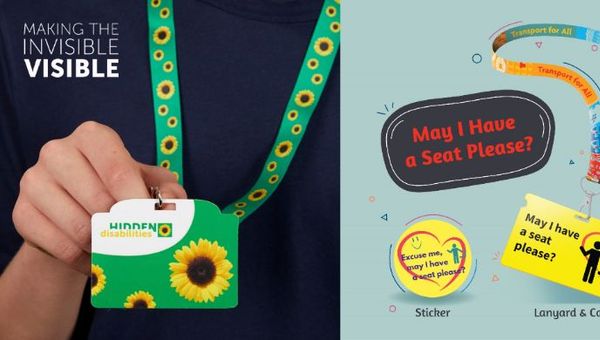
Passengers wearing any of these two lanyards denote their requirement for assistance. Photo Credit: The Hidden Disabilities Sunflower (left) and Land Transport Authority (right)
Caretakers of passengers with unseen disabilities have the option of
further enhancing their aviation experience by applying for special
lanyards.
The Hidden Disabilities Sunflower lanyard or Land Transport
Authority’s “May I Have a Seat Please” lanyard discreetly notifies
airport staff that the passenger in question may need a little more
support, guidance or time going through the various processes.
Airport staff have been trained in identifying these lanyards and taking the initiative to offer additional assistance.
Specialised ambassadors who cater to special needs
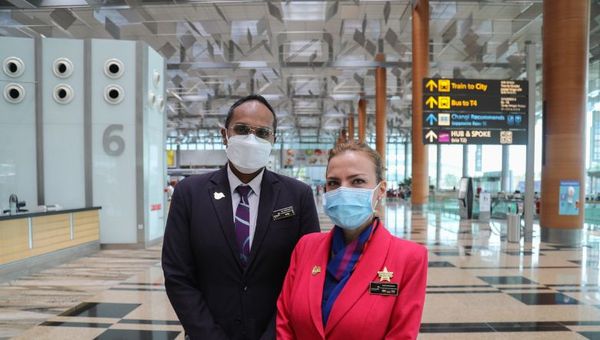
Vikneasvara Perumal and Norazman Boryana Marinova have undergone the Changi Care Ambassador training to better serve passengers with special needs. Photo Credit: Changi Airport Group
More than 300 frontline staff have undergone the Changi Care
Ambassador training programme with RCTC that allows them to identify and
meet the needs of passengers with hidden disabilities. These
specialised staff can be recognised by their gold Care Ambassador
badges. The programme will be further expanded to include more staff
this year.
This initiative is part of the group’s continuous efforts to provide
special assistance for an increasingly diversified demographic of
travellers, which has already seen the implementation of assistance when
travelling with children and for people with reduced mobility or
physical disabilities.