To stay afloat in this highly competitive travelscape, more airlines
are forking out the dough to enhance the passenger experience in hopes
of offering them more bang for their buck in light of surging airfares.
Etihad keeps travellers in the know
Etihad, which is migrating its guest communications platform from
Sabre to Amadeus Altéa, has teamed up with 15below – which specialises
in hyper-personalised, automated passenger communications - to implement
four new digital solutions.
These will further advance the Etihad’s ability to keep its
passengers in the loop with timely, relevant notifications throughout
their journey.
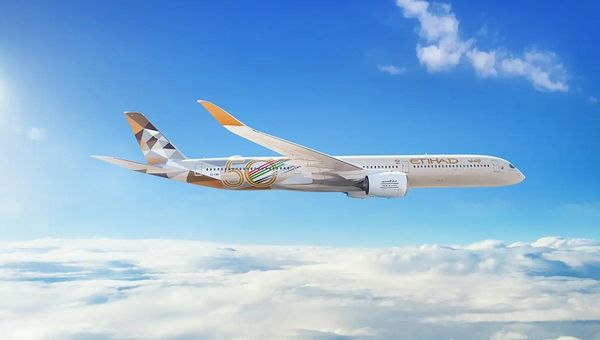
Etihad passengers to be better connected with 15below’s digital solutions. Photo Credit: Etihad
New features will include 15below’s three most popular solutions:
Disruption Communications, Queue Manager and Flight Status
Notifications.
Etihad sends notifications to passengers via email, SMS and app,
placing everything in a single view, also allowing the airline’s
operational teams to manage guest communications effectively.
Nicholas Key, CEO at 15below said, “A lack of relevant information
has always been a huge contributor to the stress that many associate
with travel, so at a time when the rules are constantly changing,
effective communication is key to passenger wellness.
“The work that we have done with Etihad gives the passenger much
greater control, promoting a smooth, risk-free travel experience where
currently there is more to think about than ever before.”
What’s neo with Malaysia Airlines?
Good news for those flying Malaysia Airlines. The carrier’s fleet
renewal programme will gather momentum with the acquisition of 20
wide-body A330-900 neo aircrafts.
Wondering what makes the neo different? It’s the new generation
version of the popular A330 widebody, incorporating the latest engines, a
new wing and a range of aerodynamic innovations.
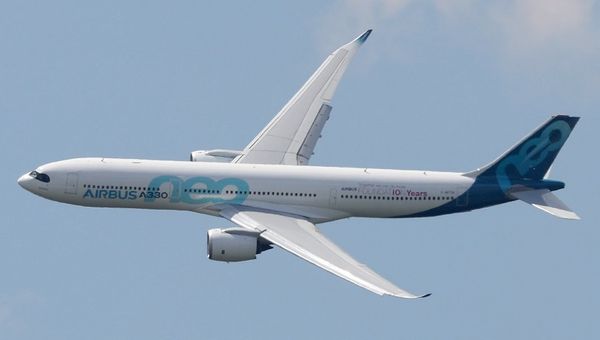
Malaysia Aviation Group said that the A330 neos would replace Malaysia Airlines’ A330 ceo aircraft, and would operate on routes to Asia, Oceania and the Middle East. Photo Credit: Wikimedia Commons
And there’s more: The aircraft offers 25% reduction in fuel consumption and CO2-emissions.
The carrier will operate the A330neo (neo stands for new engine
option) on its network covering Asia, the Pacific and the Middle East.
Christian Scherer, Airbus chief commercial officer and head of
international said, "Malaysia Airlines is one of the great Asian
carriers. This decision is a clear endorsement of the A330 neo as the
most efficient option in this size category for premium operations
experience."
Not to be outdone, Emirates splashes US$2 billion on fleet retrofit
Emirates resisted premium economy for a while but as rivals started
to fill their aircraft with higher fare-paying passengers seated further
up the aircraft, it was only a matter of time before Emirates followed
the trend.
As is the case with Emirates, the Middle East carrier is planning to
do things bigger and better than the rest, with a massive retrofit of
its fleet.
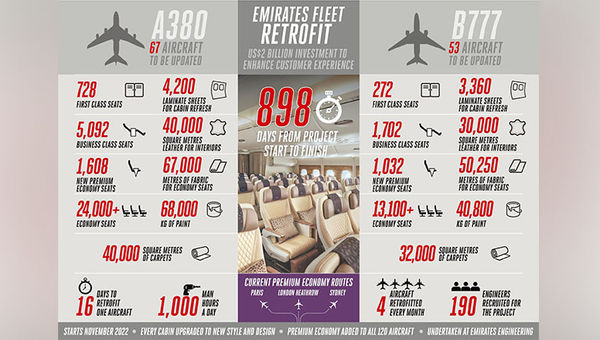
Emirates has kickstarted a US$2 billion project for the complete interior refurbishments of 120 Airbus A380 and Boeing 777 aircrafts. Photo Credit: Emirates
Emirates will upgrade the entire interior cabins of 120 Airbus A380
and Boeing 777 aircraft in what will be the largest known fleet retrofit
project, part of Emirates’ US$2 billion dollar investment to elevate
customer experience.
This will see nearly 4,000 new Premium Economy seats installed, 728
First Class suites refurbished, and more than 5,000 Business Class seats
upgraded to a new style and design. And all this by April 2025.
Emirates’ new Premium Economy cabin class, is currently available to
customers travelling on A380 routes to London, Paris and Sydney
A gas guzzler goes green
Hard to believe that the once-maligned Airbus A380 could soon be the aviation's poster child for the environmental lobby.
Berated
for its inefficient gas-guzzling four engines, the super jumbo is now
lined up to test hydrogen fuel, which Airbus, together with engine-maker
CFM International, want to introduce on a new passenger aircraft by
2035.
A modified A380 will maintain its four conventional turbines, while a
fifth engine adapted for hydrogen use will be mounted on the rear
fuselage. Emissions will be monitored separately from those of the
turbines powering the aircraft, Airbus said in a statement.