At a time when anyone can be a content creator, one travel agency in Singapore believes there is a way to ride the currents of change while professionalising user-generated content (UGC) in the travel industry.
EU Holidays has partnered a local institution to launch a new content creation training programme tailored to the travel industry. Along with Nanyang Polytechnic – Singapore Institute of Retails Studies (SIRS), the agency plans to recruit some 200 students and equip them with AI tools to create TikTok-friendly travel content over the next 12 months.
Discovery has moved to short-form videos. Travellers today find, compare and book trips through TikTok reels [and even] live selling.– Ong Hanjie, director, EU Holidays
“The travel industry has fundamentally changed. Traditional brochures and static stock photos no longer drive decision-making. Discovery has moved to short-form videos. Travellers today find, compare and book trips through TikTok reels [and even] live selling,” shared Ong Hanjie, director at EU Holidays.
Speaking at the Future-Ready SMEs: Upskill Your Workforce with Generative AI event, which forms part of the Singapore government’s SkillsFuture Festival 2026, Chung Wen Hua, director of SIRS, said: “We are translating industry best practices in digital marketing and social commerce into practical learning opportunities for businesses, individuals and the larger workforce.”
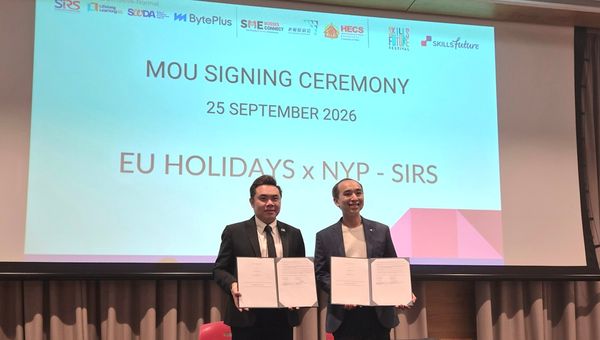
EU Holidays and Nanyang Polytechnic – Singapore Institute of Retails Studies at the MoU signing ceremony on 25 September.
Specialisation meets influencer marketing
But does the world really need more travel influencers? Maybe not in the exact form brands are familiar with.
The initiative could potentially introduce an important element of professionalisation to what seems to be an unfettered wave of UGC.
For brands who grapple with the dilemmas around UGC influence and creators' lack of industry-specialised marketing knowhow, the addition of travel agents and tour specialists – the ‘OG’ travel influencers – to the mix could make all the difference.
Describing the initiative as a step towards “ambitious workforce transformation”, Ong explained that most influencers are well-versed in short-form videos, but not so much in travel products.
In the development of new-age travel marketers, “experienced tour leaders who hold a wealth of destination knowledge” will play a key role in driving more industry-aligned storytelling in the realm of UGC.
Can anyone be a content creator?
With AI said to “level the playing field” in the current state of UGC marketing – dominated by costly, ad-hoc influencer engagement – Han expects that the initiative will address other gaps. It lowers cost barriers for SMEs wanting to succeed at UGC marketing, and builds lasting internal capabilities otherwise out of reach to smaller businesses.
Han delivered a spirited call for aspiring AI-learners in the audience: “With tools like Seedance, we can create a dream of our own.”
Pro-AI discourse was front and centre at the workforce upskilling event, which also featured presentations from BytePlus, the enterprise technology and B2B services arm of TikTok parent ByteDance. From Seedance, which turns text and photos into HD videos, to full-stack SaaS for end-to-end plug-and-play creation, the promise of having “high production value” videos ready in minutes is compelling.
Hailing the AI skills programme as a “win-win future for our workforce”, Han and ByteDance were exuberant about AI solutions placing professional creation capabilities in the hands of anyone with a story to tell.
What remains uncertain is how the relationship between AI, creators and brands will evolve. While advocates see the technology as a way to democratise content creation and expand marketing capabilities, questions around authenticity, originality and the role of creative expertise continue to be debated.
As travel brands experiment with new forms of storytelling, the challenge may lie not in choosing between AI and human creativity, but in finding the right balance between the two.