Asia’s luxury travel market is charting a strong growth trajectory, driven not only by rising wealth but also by the breadth of opportunity across a diverse region. And Virtuoso’s 2026 Forum for North and Southeast Asia, which took place 2-3 April at The Apurva Kempinski Bali, is indicative of the scale and evolution of the market in Asia.
The boom is underpinned by a surge in wealth, with assets under management across North and Southeast Asia rising from US$2 trillion in 2017 to US$6.9 trillion in 2025. A growing pool of ultra-high-net-worth individuals, alongside increasing silver and multi-generational travel, is creating a larger and more sophisticated affluent segment.
This segment, which represents just 20% of travellers but accounts for 50% of total spend, is fuelling demand for more tailored and experience-led travel. “Luxury in our region is changing – no longer about status or price,” said Raymond Ang, Virtuoso’s general manager of North and Southeast Asia. “Travellers are no long asking where to go next, but what would they experience next.”
Virtuoso has expanded its footprint in tandem with this shift. Since entering Asia in 2015, the network has established a regional office in Singapore, and reorganised its operations into separate North and Southeast Asia and Greater China divisions.
“Virtuoso's Asia agency network has grown by more than 50% over the last two years, with its travel advisor base expanding by over 70%,” said Raymond Ang, Virtuoso’s general manager of North and Southeast Asia. “We’ve also successfully entered the Vietnam market.”
The network now spans seven markets in the region – Japan, South Korea, Indonesia, Malaysia, Singapore, Thailand and Vietnam – with 27 member agencies and approximately 220 advisors. Globally, Virtuoso counts over 20,000 advisors and 2,300 partners across 58 countries, with Asia continuing to be one of its fastest-growing regions
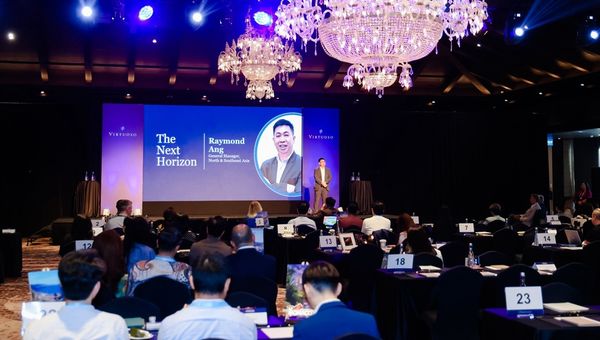
Virtuoso's Asia agency network has grown by more than 50% over the last two years, according to Raymond Ang, Virtuoso’s general manager of North and Southeast Asia.
Overriding optimism
Despite geopolitical tensions and economic headwinds, sentiment across the luxury travel sector remains broadly positive, said David Kolner, EVP, strategic communications at Virtuoso.
According to Virtuoso's Network Pulse Survey conducted in January 2026, 71% of global members describe themselves as optimistic about their business, with just 2% pessimistic. Client budgets and spend are the primary driver of that confidence (73%), followed by business financial health (52%) and a strong bookings pipeline (50%).
A separate survey of agency owners and managers conducted just before the forum paints a similar picture: nearly 70% expect sales to be higher than last year, with 45% projecting growth of 1–10%, 17% forecasting 11–20%, and 7% anticipating increases of 21–50%.
That said, geopolitical conflicts (72%) and political uncertainty (55%) were flagged as the most significant factors likely to impact luxury travel in 2026.
Beware the threat of sameness
Kolner also sounded the reminder to “beware the threat of sameness” in an age where everything is branded as luxury, a similar refrain that was repeated by Virtuoso executives during the forum. Great travel alone is no longer enough to stand out.
Sustainability is emerging as one of the clearest differentiators, increasingly framed as a business strategy rather than an ethical add-on. While few travellers explicitly request sustainable trips, 64% say they would spend more if they knew a partner or destination was genuinely committed to sustainable practices.
VP sustainability Javier Arredondo makes a push for sustainability as an advantage, urging members to find their ikigai – and increasingly sustainable travel is where purpose and profit most naturally meet. “Sustainable travel is not about doing something ‘nice’. It’s building a business that is harder to copy, easier to defend and more relevant over time,” he stated.
The human edge
Virtuoso chairman and CEO Matthew Upchurch, reflecting on his four decades with the network during the forum, underscored the irreplaceable value of human connection in an age of intelligent machines.
“I've always loved technology,” he said, “but what we really have in common is our belief that technology should enhance human connection, not replace it.” said Upchurch. With technological advantages becoming increasingly short-lived, the industry maven urged members to “automate the predictable so you can humanise the exceptional”.
He closed with a reflection on diversity as the network's competitive core. The different paths, business models, languages, cultures and ways of thinking, he argued, are strengths to be embraced.
"Diversity is not just a characteristic of this region, it is our advantage as a network."