The 2026 FIFA World Cup circus has left town, leaving the fans of Spain to celebrate their team’s success in the final, while the postmortem begins on the impact of the tournament on the hospitality industry.
With the 2030 FIFA World Cup set to span six countries across three continents, developers and destination planners are increasingly viewing stadiums not simply as sporting venues, but as catalysts for year-round tourism, hospitality and entertainment.
For the 2030 tournament, opening matches will take place in Uruguay, Argentina and Paraguay in South America before the competition moves to its main hosts of Spain, Portugal and Morocco in Europe and Africa.
This also gives ample time for property developers to assess the feasibility of building hotels in and around sports stadiums, turning these huge spaces into year-round activity centres.
Just as forward-thinking airports around the world have evolved from transport hubs into shopping, entertainment and wellness destinations, sports stadiums are increasingly being reimagined as mixed-use precincts with activity well beyond match days.
A year-round proposition
One example is the Dorsett Kai Tak property which is directly integrated into Hong Kong’s Kai Tak Sports Park. In addition to the hotel, the 28-hectare complex features extensive retail areas, dining promenades, a 10,000-seat indoor arena, and a 5,000-seat community sports ground.
In Singapore, the mixed-use Kallang Alive precinct surrounding the National Stadium will include a hotel to support major sporting events, concerts and conventions.
In Saudi Arabia, luxury hotels are being integrated into new and existing sports stadiums. Key developments include two hotels at Jeddah’s King Abdullah Sports City and dedicated motorsport hotels within Qiddiya City, offering direct views of the racetrack.
In Australia the 138-room Oval Hotel has been integrated into a grandstand at Adelaide Oval, offering stadium-view rooms of the of the 60,000-capacity venue’s sporting activities.
In the UK, Premier League Manchester City’s expansion plans at Etihad Stadium includes a 400-bed hotel, 3,000 capacity fan and hospitality zone, sky bar and roof-walk experience.
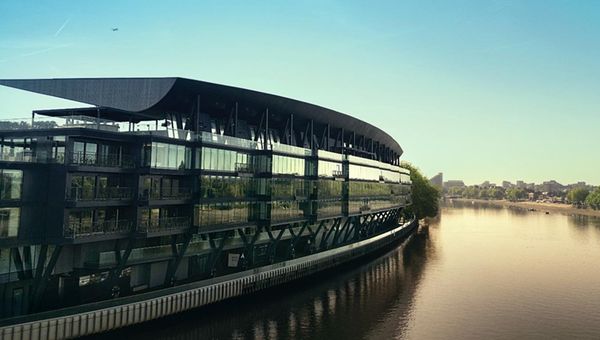
Premier League club, Fulham’s venue overlooking the River Thames. Photo Credit: Fulham Pier
Another Premier League club, Fulham, is developing Fulham Pier, which includes a luxury boutique hotel overlooking the River Thames.
The venue is being marketed as, “A new riverside destination in south-west London full of amazing places to eat and drink, plus a year-round cultural programme of events for all the family, from comedy gigs and toddler discos, to yoga and riverside chess.” Fulham Pier also includes art exhibitions, spa and wellness programmes.
Glen Sutton, director at Fulham Pier, says, “You’re not building a stadium anymore with some ancillary experiences, that is completely the wrong way to look at it.
“You are placemaking a new environment, of which the football stadium, or sports stadium, is commercially a big part, but experientially the smaller part.”