Techo International Airport, which began operations south of Phnom Penh on 9 September 2025, is the boldest bet Cambodia has placed on its tourism future. The US$2.3 billion gateway is designed for up to 15 million passengers a year, with a single 4km runway, and Etihad Airways and Turkish Airlines have added services since it opened. But what does it mean for hospitality in the Cambodian capital?
Related: What to expect at Cambodia’s new airport
Infrastructure ahead of demand
It hasn’t all been smooth sailing, though. Cambodia welcomed 5.57 million international visitors in 2025, generating US$3.878 billion in tourism revenue, but arrivals fell 44.4% year on year to 2.25 million in the first eight months of 2026, according to the Ministry of Tourism.
Tourism minister Huot Hak has attributed the downturn to negative publicity surrounding online scam networks, tensions along the Cambodia–Thailand border and conflicts in the Middle East that have pushed up fuel prices and dampened demand for travel.
Andrew Moore, managing director of Rosewood Phnom Penh, argues that the airport matters beyond capacity. “For many international visitors, the airport is always their first experience of a country,” he says. “Having a modern international gateway creates a strong first impression of a capital, and shows that it’s developing and investing in its tourism future.”
But hardware alone won’t fill rooms. “The improved connectivity needs to be matched by compelling reasons for travellers to stay,” he says, adding that a number of hotels, restaurants and cultural experiences are now offering exactly that.
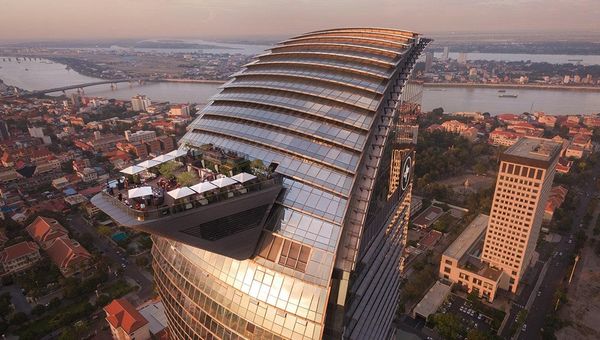
Rosewood Phnom Penh occupies the upper floors of Vattanac Capital Tower, part of a growing luxury hotel line-up helping the capital build its appeal as a destination in its own right. Credit: Rosewood Hotel Group
Moving beyond the brief stopover
Christian De Boer, managing director of Jaya House River Park in Siem Reap, describes the problem from the Angkor side. “Cambodia has been sold internationally around Angkor for decades, and too often that translates into two or three nights in Siem Reap as part of a wider Southeast Asian itinerary.”
Angkor, he says, “should be the beginning of someone’s experience of Cambodia rather than the entirety of it”, and the industry must stop packaging it otherwise: “If itineraries continue to position the country as a two-night temple stop between other Southeast Asian destinations, it is difficult to change traveller behaviour.”
Phnom Penh has a harder story to tell. “Siem Reap has Angkor, which gives travellers an immediate reason to visit, whereas Phnom Penh’s appeal is more layered and perhaps hasn’t always been communicated as clearly,” De Boer says.
Moore sees those layers accumulating: “Phnom Penh has developed a much stronger dining and bar scene, alongside history, contemporary art, independent design, local craftsmanship and a growing creative community.”
He points to the Cambodia International Film Festival, Phnom Penh Designers Week and homegrown labels such as Seekers Spirits, Samai Distillery and MAWSIM.
Guests are responding. “We do see travellers spending more time in Phnom Penh and increasingly seeing the city as a destination in its own right,” he says.
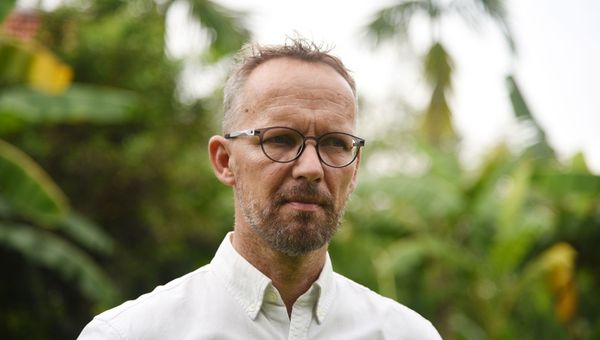
Christian De Boer, managing director of Jaya House River Park, says: “The biggest opportunity is that Cambodia still has the ability to decide what kind of tourism destination it wants to become.” On Phnom Penh, he adds: “The foundations are already there; it is about giving the city the confidence and platform to tell its own story.”
A luxury line-up with a credibility job to do
The hotel line-up has grown. Raffles Hotel Le Royal, the colonial classic, now sits alongside Sofitel Phnom Penh Phokeethra, Shangri-La Phnom Penh and Hyatt Regency Phnom Penh. The latter opened in January 2021 with 247 rooms, including 43 suites, and 1,400 square metres of meeting and event space.
Rosewood occupies the upper floors of the Vattanac Capital Tower. Moore says the city “still feels relatively undiscovered compared with some of Southeast Asia’s more established capitals”.
Whether luxury can shift perceptions is another matter. Moore says: “Luxury hospitality is one part of a much broader shift in how Cambodia is perceived internationally.”
De Boer is candid about the gap: “There can still be some outdated perceptions of Cambodia internationally, including around safety, but the reality visitors experience when they arrive is a welcoming country where they feel very comfortable travelling and exploring.”
He adds that guests are increasingly discerning: “Guests ask questions about sustainability, where products come from, who a hotel employs and how their stay benefits the local community.”
Shaping the next chapter
Both operators see the direction of travel as still open. “The biggest opportunity is that Cambodia still has the ability to decide what kind of tourism destination it wants to become,” De Boer says.
Of Phnom Penh, he adds: “The foundations are already there; it is about giving the city the confidence and platform to tell its own story.”