Southeast Asia's cruise terminals are evolving from transport hubs into tourism gateways, investing in technology, destination development and sustainability as the region prepares for its next wave of cruise growth.
At the recent CruiseWorld Malaysia 2026, cruise port leaders from Singapore, Penang and Sarawak shared how passenger expectations are reshaping terminals. The focus is no longer simply moving travellers efficiently, but creating memorable first impressions, improving operational resilience and strengthening the wider tourism ecosystem so Southeast Asia stands as a competitive year-round cruise destination.
Singapore: The cruise gateway experience
Marina Bay Cruise Centre Singapore (MBCCS) has shifted its focus beyond infrastructure following its revamp last October.
Gregory Tan, CEO of SATS-Creuers Cruise Services, said the redevelopment has eliminated previous congestion by providing dedicated embarkation areas for each cruise line while significantly increasing operational resilience.
More importantly, MBCC is positioning itself as the first chapter of the Singapore visitor experience rather than simply a boarding point.
"We do not just view the Marina Bay Cruise Centre Singapore as infrastructure, as a cruise port alone. We take a broader view that it is a gateway into Singapore and its larger tourism offerings.”
Technology will play an increasing role in that vision. MBCCS is investing in artificial intelligence, CCTV analytics and licence plate recognition to better understand passenger movement, improve traffic flow and integrate the terminal more closely with Singapore's tourism precincts.
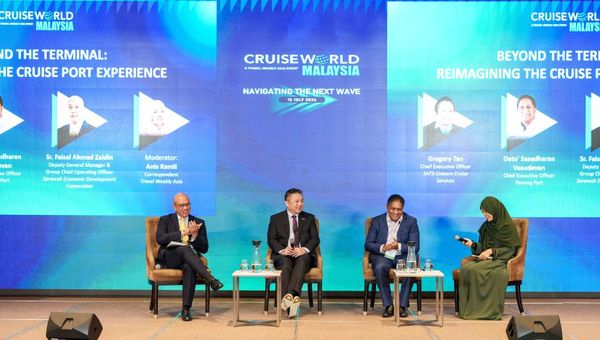
Port operators in Singapore, Penang and Sarawak at CruiseWorld Malaysia 2026.
Penang: Smoother arrival experience
Following a RM100 million post-pandemic investment, the quay wall has expanded from 540 metres to 840 metres, enabling the port to berth two mega cruise ships simultaneously or up to four vessels at once. The terminal can now accommodate around 12,000 passengers.
CEO Sasedharan Vasudevan noted that the upgrades extend beyond capacity. New fenders improve berthing efficiency, while upgraded washrooms and stronger Wi-Fi coverage are designed to create a smoother arrival experience for passengers and tour operators. Adjacent to the cruise terminal, an upcoming 2,000sqm ground transport area is expected to better manage the arrival of up to 80 buses serving mega ships.
“Our capacity is actually driven by the eight to 10 percent deployment that we’re looking at in Asia and the growth of the shipbuilding workforce with 30 mega luxury ships expected in the next few years,” he pointed out.
To further streamline shore excursions, Penang plans to launch a digital platform in January 2027 allowing passengers to pre-book transport before arriving, with future phases incorporating attractions and destination information.
"We are certainly going the path of digital platform," Sasedharan said.
Sarawak: New cruise terminal in development
In East Malaysia, Sarawak’s Damai International Cruise Terminal, now under development, is intended to become the catalyst for a broader tourism masterplan extending to 2030.
Deputy general manager and group COO of Sarawak Economic Development Corporation (SEDC), Faisal Ahmad Zaidin, said the project is designed to fill a long-standing gap in regional cruise itineraries, which have traditionally bypassed Sarawak since suitable cruise infrastructure did not exist.
Rather than functioning solely as a port, the development will combine a cruise terminal with hospitality, marina facilities, cultural attractions and mixed-use developments while maintaining a strong focus on ecotourism and community benefits.
"The terminal will not be designed simply as a place for ships to dock, but as a gateway for experience."
Sarawak aims to establish itself as a regular regional cruise call stop after opening, alongside balancing environmental stewardship, cultural preservation and community wellbeing.
The next wave
While Singapore, Penang and Sarawak are at different stages of their cruise journeys, they share a common ambition to make the port itself part of the destination to strengthen the region’s collective appeal.
Penang is preparing for future sustainability requirements, including shore power and broader green port strategies.
“There’s a lot of pressure for ports to become greener and practice sustainable tourism,” said Sasedharan.
MBCCS' Tan added Southeast Asia's greatest strength remains its growing network of complementary destinations operating year-round.
"I'm very excited to hear about Borneo, Sarawak coming on stream," he said. "Together, prosperity is for us to gather for both sides of Malaysia, east and west, and together, we will really succeed."
Related: SEA rising: When ports become pathways