Amidst the vibrant discussions on the future of the cruising industry at CruiseWorld Asia on 7 November,
the sessions exploring travel technology and innovation led by new-gen
travel leaders sparked thought-provoking insights. These included
innovative approaches to engaging travellers and candid reflections on
the contemporary perception of travel agents.
Innovation, and the undeniable role of AI
What does one do with an entire in-house fleet of buses that aren’t
actively utilised? Singapore's WTS Travel & Tours creatively repurposed
their underutilised bus fleet into ‘The Bus Collective’, a unique
staycation experience on refurbished single-decker buses.
Joshua Sia, assistant manager of business development at WTS Travel
& Tours, also revealed that the company innovatively combined their
coaching strength with cruises, offering one-way coach to Port Klang
with a cruise return, benefiting coach-averse customers by avoiding
traffic jams.
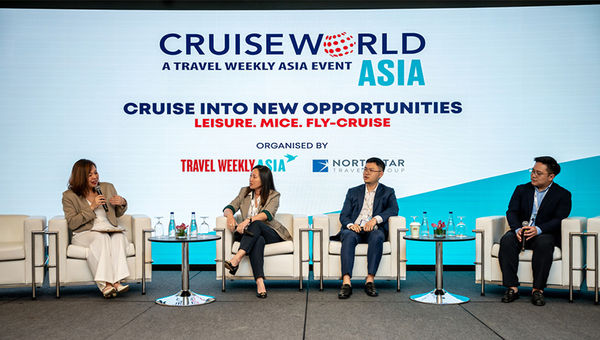
From left: Travel Weekly Asia’s Xinyi Liang-Pholsena; WonderGoLander’s Javiny Lim; TLC Travel & Tours' Lai Khe Han; WTS Travel & Tours' Joshua Sia
Then there’s the digital component.
An example of using artificial intelligence (AI) is placing a
potential customer into a photo – so they can visually see themselves on
the cruise and/or destination. “You can show this and edit based on
real-time feedback. It’s a completely different level of engagement,”
said Glenn Gore, CEO of Affinidi.
Another reason for such a practice is to sidestep copyright issues
traditionally associated with using actual photos, explained Lai Khe
Han, director, TLC Travel & Tours.
However, not everyone is fully onboard the AI bandwagon. Javiny Lim,
managing director and co-founder of luxury travel curator
WonderGolander, mentioned they outsourced research to AI and
experimented with chatbots and social media marketing. Yet, the return
on investment didn't align with their mature target audience.
Travel agents: It’s still down to trust
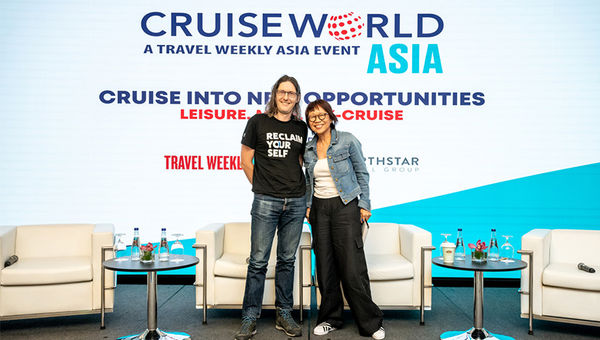
From left: Affinidi’s Glenn Gore and WIT’s Yeoh Siew Hoon.
Like it or not, the role of travel agents has evolved, demanding
digital skills. However, it need not be an exclusive choice between the
two.
“Don’t just think of chatbots as a way of reducing costs. It’s about
reserving the humans you have to have the most meaningful conversations
with your customers, which could not be served by AI,” said Gore.
Sia of WTS Travel & Tours sees it from this perspective: “We are
curators – that’s how we should position ourselves. Even with [AI-aided]
trip planning, we are the final 10% to bring customers to the next
[level].
“We want to change the perception of how travel agents are viewed.
For people among my generation, there’s a pushback against agents,
because on the top of their minds it’s about packages – which is the top
antithesis – and they don’t find value [in us] especially if they can
use AI.”
Added Gore, “If I’m going to spend a lot of money on a trip, I
[still] want to look at a human in the eye and say, ‘Have you sent
people there? What was their experience like? I trust you.’”
Ultimately, when putting technology and humans side by side, travel still is a relationship business.
Summing up sentiments in the room, Xinyi Liang-Pholsena, senior
editor at Travel Weekly Asia noted, “AI will not replace relationships.
It is still what defines the travel sector: experience, professionalism,
service that will keep customers coming back.”