Asia-Pacific travellers are increasingly turning to AI for the functional side of trip planning, from research and budgeting to translation and logistics. But when it comes to deciding what looks worth doing, where to go and whether a recommendation can be trusted, social media still has an important role to play.
That was one of the central messages from Marcus Yong, vice-president of global marketing at Klook, speaking at WiT Singapore, where he shared findings from Klook’s research, including a study commissioned for the conference, and outlined what he called the “five truths” of social commerce.
The findings point to a travel purchase journey that is becoming less linear, with travellers moving between AI, social platforms, search, reviews and booking sites before making a decision.
He began with a short history of travel discovery: first the Lonely Planet guidebook, then a Google search for "things to do". Today, he said, planning is split between a "left brain" and a "right brain".
AI sits on the left. Klook Travel Pulse 2026 data found that 94% of APAC travellers have used AI for travel planning, mostly for translation, budgeting, research and trip logistics. "Very left-brain stuff," Yong said. "But what happens when you need to be inspired? That's where social media comes in."
Social media's influence on buying is hard to ignore: 80% of respondents said they had booked an experience or visited a destination because of a social recommendation. "That number, ladies and gentlemen, is not small," Yong said, adding that he was one of them.
Social commerce can mean checking out inside a social app, handing creators trackable promo codes, or livestream selling. “It can be anything you want. It can be all of it," he said. "The most important thing is how you, as a brand, can connect social engagement to bookings.”
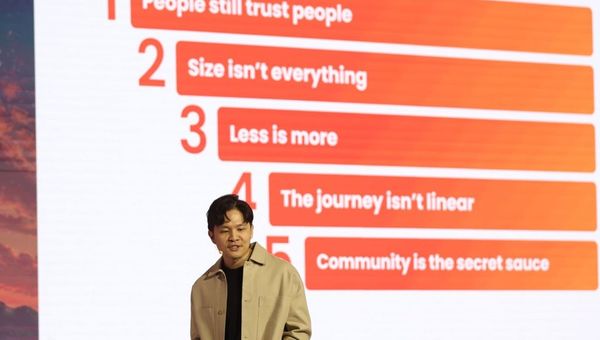
Klook’s vice president of global marketing, Marcus Yong, told WiT Singapore delegates that social commerce has moved from inspiration to transaction, but the path to the booking button is messier, smaller and more human than most brands assume. Photo Credit: Marcus Yong/LinkedIn
Truth #1: people still trust people
"The machines have risen, but people still very much trust people," Yong said.
According to Klook's survey, 85% of APAC travellers do not take AI at face value. They use it, but they do not believe it can produce trust or authenticity. The result is a two-step habit: travellers ask AI for recommendations, then search social media to check that real people have done it and to see what it actually felt like.
That is why Klook flew 127 creators from 17 markets to Vietnam for Kreatorverse 2026, an eight-day, seven-night programme across Da Nang and Phu Quoc, instead of sending them a brief and leaving them to make content with AI. The trip produced more than 1,000 posts and 33 million impressions.
"A lot of people ask me, is the effort worth it?" Yong said. "The reason why we did this is because we realised that authenticity always wins." Social proof, he added, "complements that AI journey" rather than competing with it.
Truth #2: size is not everything
Most Klook Kreators are not celebrities. More than two-thirds are nano and micro creators, with audiences of up to about 50,000 followers.
"Unlike popular belief, where people think, do you guys go after mega influencers? It's actually the micro and nano that's driving a lot of the social commerce conversions," Yong said.
Klook's data puts micro creators second only to friends and family as a booking trigger, with one in three travellers saying they would book an experience because of one.
The content that converts is useful rather than glossy. In Klook's Social Commerce Survey from September 2026, 38% of travellers named detailed, step-by-step guides and tips as the content most likely to make them book. Another 29% chose real-time, behind-the-scenes proof. Cinematic visuals got 17% and exclusive perks and discounts 14%. A how-to-get-there video beats a drone shot.
The machines have risen, but people still very much trust people.
Truth #3: less is more
Brands, Yong admitted, are greedy, and he included himself. Eight in 10 creators told Klook that brands want everything from one campaign: views, engagement, conversions, top of funnel and bottom of funnel.
"What they want is something very simple: less," he said. "But let them go forth and flourish to achieve that objective you want."
Klook boils its programme down to three metrics: views and impressions, engagement, and direct bookings and sales. Each initiative is built around one of them. Creator Picks, its sponsorship programme, is measured on views and impressions. "There's honestly a million metrics out there," Yong said. "Know what your brand wants and create those initiatives for the influencers and creators that you're working with."
Truth #4: the journey is never linear
Yong summed up his fourth truth on one slide: content is not checkout.
"Commerce actually doesn't really happen on social media," he said. Only 11% of consumers want to buy inside the app after seeing a creator's content. Three in four travellers click a link in social content but do not book straight away. Instead, they save the video and keep researching.
A travel experience takes a lot of thought before people buy. Travellers drop off to compare prices, check availability and go back to social media for more reviews from real people. "You can jump from one to three, three to four, four back to one," Yong said of the path from discovery to consideration to purchase. "It's not a linear journey, and it's impossible to track that way."
Klook uses two tools to bridge the gap: a unique referral code for every creator, and newly launched creator shopfronts, which give each creator a personalised storefront in the Klook app. Yong was frank that attribution is still hard. If someone uses a code and also comes through a shopfront, who gets the credit? "There's a lot of messy plumbing," he said.
Truth #5: community is the secret sauce
Half of Klook's active creator base has been with the programme since it started, and none of them have gone quiet. When Klook asked creators what keeps them around, trust and community came first, then brand reputation. Payouts and tools came last.
So Klook keeps investing in the people behind the posts, with workshops, hackathons and summits. At one session, one of Malaysia's longest-standing influencers ran a three-hour workshop teaching smaller creators how to make better content. "But if you invest in it, it's worth it."
He closed with what keeps Klook's social commerce engine running, the three Cs: content, commerce and community. His message to the room was simple: let AI handle the logistics, but don't let it near the trust.