If any operator has made sleep a serious hospitality proposition, it is Equinox Hotels.
The US brand has spent the past decade building out sleep-scientist-vetted guestrooms, circadian-aligned AM and PM rituals, and a Jet Lag Reset tool. It has gone further still with a formal partnership with Berkeley sleep scientist Dr Matthew Walker and a Sleep Lab at its New York flagship, where guests take part in live sleep studies rather than simply booking a treatment.
Japan has taken the science furthest into the mainstream. Nine Hours, the design-led capsule hotel chain, has spent recent years turning an overnight pod stay into genuine sleep research: its “9h sleep fitscan” uses infrared cameras, microphones and body sensors to track heartbeat, breathing, snoring and movement through the night.
At Six Senses, meanwhile, sleep is embedded into the brand’s wider wellness proposition. “Sleep With Six Senses”, developed with sleep physician Dr Michael Breus, is applied across the group’s properties, from handmade mattresses and temperature-regulating bedding to sleep tracking paired with a personal consultation. Six Senses Con Dao in Vietnam takes the concept further with a dedicated Sleep Program overseen by integrated wellbeing practitioner Yaazhini Pugazhendhi.
The approaches differ, but they point to the same shift: sleep is no longer simply something that happens between check-in and check-out. Hotels are increasingly treating it as an integral part of the wellbeing experience.
Does sleep need to be a programme?
Not every hotel believes better sleep needs to be turned into a treatment.
At Banyan Tree Samui, that shift shows up as demand for structure. “We are seeing growing interest from travellers seeking better rest, stress reduction, and overall wellbeing,” said Bikram Keshari Patra, the resort’s wellbeing practitioner and Ayurvedic specialist.
The Wellbeing Sanctuary offers Sleep Meditation and Sound Bath Meditation alongside a 90-minute Sleep Essentials Massage Therapy, while an in-villa Night Ritual can be arranged through a villa host or wellbeing consultation.
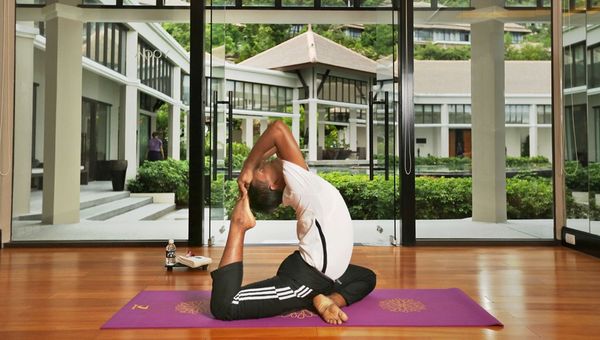
Banyan Tree Samui sees growing interest from travellers seeking better rest, stress reduction, and overall wellbeing.
For Patra, the category has outgrown novelty status: “Sleep has become an increasingly important pillar of wellness, alongside mindfulness, movement, nutrition, and stress management.” His advice to advisors sending clients his way is correspondingly practical: “Travel advisors should look for properties that combine a peaceful environment with meaningful wellbeing experiences.”
At 1 Hotel Tokyo, which opened in March 2026, the philosophy is almost the opposite. The hotel does not offer a dedicated sleep programme. Instead, general manager Masato Kominami sees rest as the natural outcome of a stay designed around overall wellbeing.
Guests can choose from yoga and breathwork sessions, floating sound therapy, treatments at Bamford Wellness Spa and a 24-hour Technogym fitness centre. For Kominami, that points to a wider shift rather than a niche interest: “Wellness has become an expectation across multiple traveller segments.”
His advice for matching clients to the hotel leans away from packaging entirely. “We believe wellness is not defined by a single programme, but by a collection of thoughtful experiences that create space to slow down, reconnect with nature, and leave feeling restored,” he says.
The greatest luxury isn’t what you do on a trip, it’s leaving a destination feeling genuinely renewed.– Hervé Duboscq, General Manager, Anantara Desaru Coast
From optimisation to restoration
The same shift can be seen in the broader wellness proposition, where some hotels are moving away from prescriptive programmes towards a more holistic idea of recovery.
The Standard, Hua Hin has gone further still, repositioning in early 2026 around what general manager Natalie Cockayne calls “playful wellness”, a deliberate rejection of the prescriptive retreat model.
Rather than a schedule, guests get a menu: yoga, spa treatments, an ice bath or mud lounge session, and Contrast Therapy alternating between ice bath and sauna. “We believe recovery doesn’t have to mean retreating from life,” Cockayne says; “it can be about finding a better balance between movement, rest, good food, socialising and simply enjoying yourself.”
Underpinning the approach is a simple philosophy: “Lifestyle is about how you choose to balance and live your life.” The property recommends just two to three nights, pitched explicitly at a long weekend or midweek escape – long enough, as Cockayne puts it, because “that is really what recovery should feel like: having the space to look after yourself, while still enjoying all the things that make a holiday feel like a holiday.”
At Anantara Desaru Coast, the emphasis shifts again, this time towards environment over itinerary. General manager Hervé Duboscq describes the change in guest expectations in near-absolute terms: “Today’s luxury traveller isn’t just seeking a getaway; they’re seeking the luxury of time to slow down, disconnect and truly restore.”
Rather than a spa-led programme, the property leans on in-room details – premium mattresses, a pillow menu, personalised turndown – supplemented by morning nature walks and workshop-style sessions.
Duboscq is candid that the experience should not feel clinical. “We don’t want sleep to feel like another activity guests have to schedule into their holiday,” he said. “The greatest luxury isn’t what you do on a trip, it’s leaving a destination feeling genuinely renewed.”
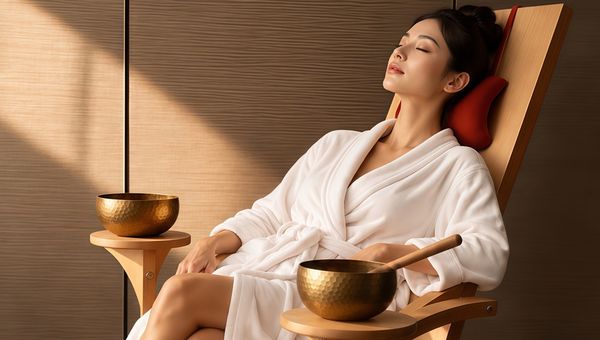
A restorative sound healing experience at Jumeirah Nanjing.
Jumeirah Nanjing takes the most back-to-basics route of the five, aimed squarely at a business-travel audience. Rather than building out a wellness menu, its team points to the fundamentals of the room itself: “A comfortable mattress, the right pillow, room temperature, lighting and, very importantly, quietness all make a real difference.”
The framing is less about hours slept than the transition into rest. For many business guests, “the issue is not simply getting enough hours of sleep, but being able to switch off properly at the end of the day”, addressed through an evening wind-down and a morning routine that includes a riverside jog and breakfast.
Its guidance to advisors doubles as a summary of the whole category’s current moment: “The important thing is to understand what helps that particular guest rest well, rather than choosing a hotel just because it offers a wellness programme.”