AI can recommend a hotel that doesn’t exist.
That was one of the lessons from The Ascott Limited’s early exploration with artificial intelligence, which included “hallucinating chatbots” that recommended entirely fictional properties, according to Kevin Goh, CEO of The Ascott Limited and CEO, Lodging, CapitaLand Investment.
The experience highlights a fundamental challenge for hospitality companies adopting AI. While the technology promises greater efficiency and personalisation, its outputs must be reliable, and its applications must address genuine business needs.
For Goh, that starts with making existing technology work better together. At Ascott, its revenue management, central reservations and property management systems are connected, allowing the company to extract and analyse data for insights that can improve operations.
“With every tech proposal, there is always a discipline to ensure an ROI. Is it to increase revenue or productivity, save costs, or address a manpower issue?” said Goh.
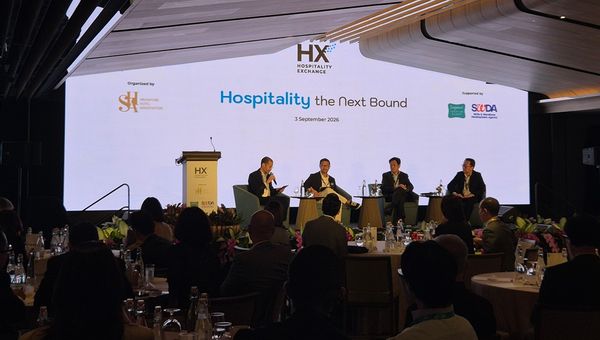
From left: moderator Mark Rohner, managing director of Far East Hospitality; Gavin Rodrigo, senior director, technology field services, Asia Pacific excluding China, Hilton; Kevin Goh, CEO of The Ascott Limited and CEO, Lodging, CapitaLand Investment; and Lim Ke-Vin, head of group innovation, City Developments Ltd. Photo Credit: Melissa Choo
For Max Del Vita, founder of Symplehost.ai, that also means resisting the temptation to let AI make decisions without appropriate oversight.
The goal should be to use AI to eliminate grunt work, facilitate collaboration and speed up workflows, rather than allowing the technology to make decisions on its own.
“Treat it as a new hire. Start small,” he advised. “If you had a new hire, you wouldn't allow them to do whatever they want, right? It needs to be a step-by-step approach. The best way to do it is to identify small problems, small high-friction, high-frequency tasks. Then go through the same process that you will do with a new hire.”
These observations form part of a panel discussion at the Singapore Hotel Association’s Hospitality Exchange 2026 conference, examining how hospitality companies can use technology to improve efficiency, personalise guest experiences and solve operational challenges without losing the human connection at the heart of the industry.
Here are the key takeaways:
Personalisation starts with knowing what guests want
The challenge for hotel groups is not simply choosing the right technology, but ensuring it can work across different operating environments and deliver value at scale.
At Hilton, the focus is on reducing friction throughout the guest journey while recognising that not every traveller wants the same level of digital interaction.
“We are in hospitality, a business of people serving people. We have road warriors who simply want digital options, and leisure travellers who want that interaction. How do you balance that? That is really the game we are in today,” Rodrigo said.
I think hospitality is probably one of the most complex industries for technology, as we are working across multiple brands, tiers, ownership models, regulations and countries that we have to navigate.– Gavin Rodrigo, senior director, technology field services, Asia Pacific excluding China, Hilton
Hilton’s technology investments include the Hilton Honors app, which is integrated across the guest journey. Guests can make bookings, select their preferred room and floor, check in online and access their room using a digital key within the app.
Its guest messaging platform connects with channels such as WhatsApp and LINE, enabling guests to share stay preferences, make pre-arrival requests and resolve issues more easily.
The group, which has more than 1,300 properties across Asia Pacific, also has the Hilton AI Planner, designed to match travellers with suitable properties for their ideal holiday.
“Let’s say I want to fly somewhere with my children within a three-hour flight radius, and I want certain amenities for my stay. AI can help create those personalised stays, connecting the right travellers with the right property at the right time.”
The operational value of AI behind the scenes
While guest-facing AI tends to attract headlines, some of the most immediate and measurable opportunities are emerging in the back office.
City Developments Ltd (CDL), which operates Millennium Hotels and Resorts, is exploring AI-native solutions to improve the energy efficiency of its air-conditioning systems, as well as staffing requirements and asset performance across its portfolio of hotels, serviced apartments, co-living spaces and student accommodation.
Computer vision is another practical application being used for room, common-area and regulatory inspections, replacing physical ones.
As vendors increasingly embed AI into software, the technology is becoming integrated throughout the hospitality value chain. That also requires hospitality companies to be more prudent.
“I think AI is pervasive across all segments but is taking root a lot more in the back-office, as it’s an area that you can ringfence. The customer-facing side is where we have to be more careful,” said The Ascott’s Goh. “What risks are you opening yourself up to, and how do you safeguard against them effectively?”
Related: From RedNote to Google to AI: What drives Asian travellers to book?
Innovation from the frontline
Some of the most impactful innovations originate with hotel teams identifying practical ways to improve operations, rather than solely from corporate technology departments.
Goh cited the example of an Ascott front-office employee with a previous background in technology, who found the company’s guest and housekeeping reporting systems cumbersome. The employee subsequently layered a large language model over the systems, enabling staff to retrieve key information more easily for reports.
With every tech proposal, there is always a discipline to ensure an ROI. Is it to increase revenue or productivity, save costs, or address a manpower issue?– Kevin Goh, CEO of The Ascott Limited and CEO, Lodging, CapitaLand Investment
“Because he came from the tech world, he was able to think about how to make these operations more efficient,” Goh recalled. “Today, some of his work has been implemented in our hotels globally.”
Front-office staff can now use natural-language prompts to request reports, such as identifying VIP guests staying at a hotel during a specified period or arranging limousine services for guests arriving the next day. “The data is then retrieved quickly in a very user-friendly manner,” he added.
Do not surrender human oversight
Organisations that succeed with AI are not necessarily those that deploy it everywhere at once, said Del Vita, but those that solve one problem at a time and progressively increase complexity and productivity. This means being clear about what information AI can access and change, when human approval is required, and how outputs will be verified.
“Get clarity on what you are trying to achieve. Understand your business processes, your workforce and who is responsible,” Del Vita explained. “Then AI can come in to take on part or all of their workflow.”
Most importantly, he urged organisations not to surrender human judgement.
“A lot of times, people deploy AI but do not spend time verifying the outcome,” he cautioned. “Unfortunately, AI is built to please you because it is a goal-driven technology. When it keeps telling you, ‘You’re absolutely right’, that’s when you know you have to stop and question the results.”
AI is built to please you because it is a goal-driven technology. When it keeps telling you, ‘You’re absolutely right’, that’s when you know you have to stop and question the results.– Max Del Vita, founder, Symplehost.ai
The goal should be to use AI to eliminate grunt work, facilitate collaboration and speed up workflows, rather than allowing the technology to make decisions on its own.
“Especially in the hotel business, people will not be replaced by robots,” Del Vita stressed. “This industry is based on human relationships, and people-to-people connections are still very important. I hope AI technology will help organisations become faster and more efficient, while still remaining human.”