When the opportunity arose to visit the Galapagos Islands but the
timing meant my son would miss two days of school, I hesitated for about
30 seconds. The famed archipelago is, after all, a natural classroom.
But because I was traveling with Lindblad Expeditions-National
Geographic, it ended up being a complete educational immersion. From
learning the difference between a spatter cone and a cinder cone to
distinguishing species based on being endemic, introduced or adaptive,
the naturalists on the National Geographic Islander II gave my son a
science lesson he'll never forget, in a way that didn't for one second
feel like school.
Lindblad launched its National Geographic Global Explorers programme
for kids 18 and under in 2017. Designed in conjunction with National
Geographic Education, it was introduced on its Galapagos sailings and
has since expanded to Baja, Alaska and, in 2021, to Antarctica.
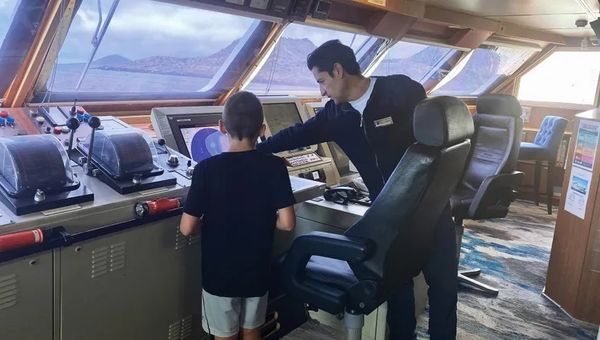
The author's son gets a lesson on the bridge on Lindblad Expeditions' National Geographic Islander II. Photo Credit: Johanna Jainchill
Sven Lindblad, founder of Lindblad Expeditions, said in a video
introducing the programme that it is "really trying to help kids get
more integrated into the experience in a variety of ways, science
projects and such .... And I'm convinced that many of these kids who
come with us here to the Galapagos Islands and other parts of the world,
having been exposed to scientists, naturalists, geography, they are the
future explorers. No question about it."
That may be the case with my kid, who ate up all of the science and
exploring during our six days on the ship and now talks about being an
onboard naturalist himself one day.
Aside from thoroughly filling out the Field Notebook every Global
Explorer gets upon boarding, with information about the activities kids
are encouraged to complete both on the ship and "in the field" (on
land), he was glued to the Lindblad naturalists on every island
excursion, where they patiently answered and explained all the questions
a 9-year-old surrounded by sharks, sea lions and volcanoes is bound to
have.
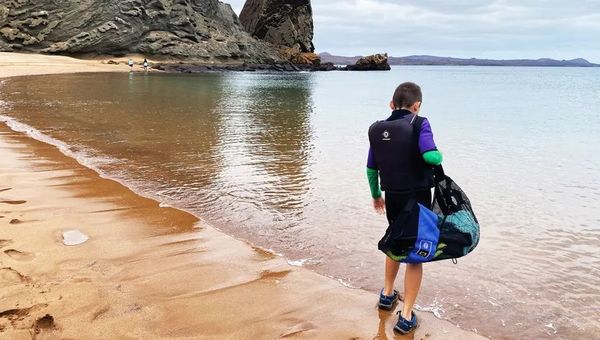
A child lugs snorkeling gear on the beach on Bartolome Island in the Galapagos. Photo Credit: Johanna Jainchill
The naturalists tailor the Global Explorers experience to the number
and ages of the kids onboard. Popular on all trips is getting a Zodiac
"driver's license" and, depending on the location, may include
collecting plankton and viewing it under a microscope or creating slow
motion and time-lapse videos with a National Geographic certified photo
instructor.
On our trip, my son kept track of daily water temperatures (and
learned which currents make the Galapagos' water as chilly as it is) and
got a private tour of the bridge with a first officer who explained how
a compass, chart plotter and fathometer work. He was proud to then
teach me the difference between a mile and nautical mile.
A highlight of the sailing for him was standing alongside Paulina,
the main organiser of the Global Explorers programme on the Islander II,
presenting to the rest of the passengers onboard an assignment to
invent a species, with a thorough explanation of what traits it has and
why.
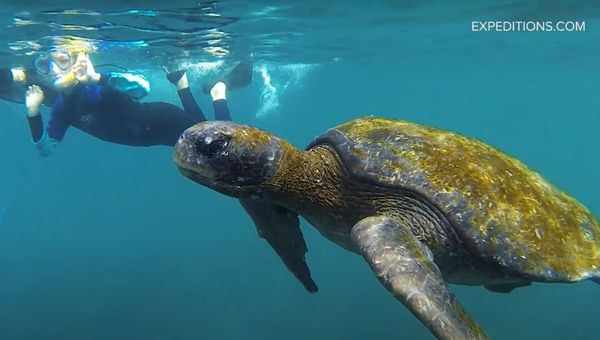
Children may even have the chance to snorkel alongside sea turtles in the Galapagos. Photo Credit: Lindblad Expeditions-National Geographic
Even without the programme there is plenty to do and learn on a
Galapagos sailing. Snorkeling, kayaking, hiking and the abundance of
wildlife would keep any kid occupied on vacation. But Global Explorers
adds a real depth to the experience. One of my favorite things about the
Field Notebook, in which kids also draw pictures and write facts about
the wildlife and geological formations they see, is that it serves as a
permanent memory of the trip, one we've looked at several times since
returning home.
And while my son may never drive a Zodiac again, he'll always have
his write-up of the experience: "It was superfun. Shaky at the start.
Then I got the hang of it, and I went really fast."
Source: Travel Weekly