Southeast Asia may account for just 2% of global cruise passengers, but it punches well above its weight economically, generating US$2,564 (S$3,308) per passenger visit, 2.4 times the global average, according to the Economic Impact Assessment of Cruise Tourism for Southeast Asian Countries by Tourism Economics for the Cruise Lines International Association (CLIA).
Yet while the region's cruise market is growing rapidly, the way travellers discover, choose and experience a cruise varies significantly from one market to another, according to travel agents from Indonesia, Singapore, Malaysia, Thailand and the Philippines at CruiseWorld Asia 2026.
Singapore prefers a tailored fit
In Singapore, the region’s most mature cruise market, Steven Ler, director and head of travel at UOB Travel Planners, said the travel agent’s role is ultimately to complete the travel experience by working around the customer’s schedule, timing and needs, and bringing those elements together.
“There are broadly two segments of customers,” said Ler. “The regular cruise customers. who have been cruising for some time, know exactly what they want and often come with very specific requests, whether it is the product, the type of suite or the dates they are looking for.”
“Then we have customers who are new to cruising and may initially be hesitant,” he added. For this latter, friends and social groups will be a good way to convert them into cruisers.
Ler noted that there will always be “diehard brand followers” who return to the same cruise brand, perhaps travelling on different ships or in different seasons. At the same time, some customers who have fulfilled their desire for ocean cruises want to try river cruises.
Again, it comes down to understanding their appetite, lifestyle and interests, then offering suitable options.
EU Holidays, on the other hand, has launched its first river-cruise charter this year, differentiating the experience by customising a gala night and entertainment, and adapting menus to suit Singaporean tastes.
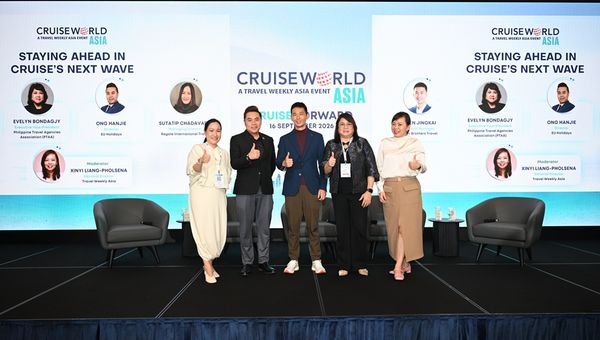
Travel agents at CruiseWorld Asia 2026: Regale International’s Sutatip Chadavadh; EU Holidays' Ong Hanjie; Chan Brothers Travel’s Chen Jingkai; Philippine Travel Agencies Association’s Evelyn Bondagjy and Travel Weekly Asia’s Xinyi Liang-Pholsena.
Malaysia relies on trusted voices
Malaysia’s cruise market is rapidly scaling up, but still offers significant potential for growth. Khe Han Lai, director of TLC Travel & Tours, said customers rely heavily on opinion leaders within their family or group of friends.
Many know little about cruising. In a group of 20, perhaps only one to three travellers may have cruise experience or product knowledge.
When organising a group trip, they usually consult a travel agent. However, there is often an intermediary within the group, an opinion leader who has greater knowledge of cruising and gathers information from the agent to share with the rest of the group.
These opinion leaders often help bring groups together, and a significant proportion of group cruise sales comes through this channel.
Indonesia weighs value and variety
Cruise holidays remain in high demand in Indonesia, but departure dates and trip duration are the main deciding factors. Unlike some other travellers, most Indonesians prefer itineraries with more port calls, shunning long periods at sea because they are concerned about becoming bored.
They are also more likely to compare the cost of a cruise holiday with that of a land tour. If they perceive a cruise as significantly more expensive, they may choose a land-based holiday instead.
“The major bottleneck we are facing in Indonesia is the high price of air tickets to Singapore,” said Pauline Suharno, president of ASTINDO.
The major bottleneck we are facing in Indonesia is the high price of air tickets to Singapore.– Pauline Suharno, president, ASTINDO
Travel agents need to understand cruise products well enough to sell their value and differentiate the experience, rather than simply selling the cabin, she added.
Citing the Forever Broadway show on Genting Dream, Suharno said agents could explain the quality of the performance and point out that tickets for a show of this standard in London’s West End could cost around US$85, even at the lowest price point. In New York, the lowest-priced tickets can cost around US$120.
Agents can then explain the value of the cruise package, which includes transport, world-class dining, five-star accommodation and Broadway-standard entertainment.
Philippines eyes untapped demand
The Philippines’ cruise market is growing, with considerable scope to reach customers who have yet to take a cruise holiday.
Evelyn Bondagjy, executive vice-president of the Philippine Travel Agencies Association, sees strong potential among families, Millennials and Gen Z, all of whom are travelling more frequently.
There are still many untapped customers that we can serve. We see strong potential among families and Millennials and Gen Z, who are increasingly travelling.– Evelyn Bondagjy, executive vice-president, Philippine Travel Agencies Association
“I think there are still many untapped customers that we can serve,” she said. “We see strong potential among families and Millennials and Gen Z, who are increasingly travelling.”
For cruise lines and travel agents, the opportunity lies in developing products and experiences that connect with these expanding segments, from multigenerational holidays to shorter, experience-led sailings.
Thailand buys into experience
Thailand’s cruise market has significant potential for growth across various segments, including younger travellers, families, luxury travellers and first-time cruisers.
Thailand remains a relatively small cruise market, but consumer behaviour is changing. Sutatip Chadavadh, managing director of Regale International Travel, said: “People today are increasingly willing to pay for experiences. It is no longer simply about the budget; consumers are looking more closely at the value they get from a cruise holiday.”
She added that the development of new cruise products, along with efforts by cruise lines and travel agents, has helped educate the market. Travellers now have a much better understanding of what a cruise has to offer and how they can enjoy the experience.
Related: Cruise Forward: The key trends steering Asia’s cruise industry