Southeast Asia remains the world’s leading Muslim tourist
destination, according to the latest edition of the
Mastercard-CrescentRating Global Muslim Travel Index (GMTI). This was
announced at the recent Halal In Travel Global Summit 2024, held from
28-30 May.
Among Organization of Islamic Cooperation (OIC) destinations,
Malaysia and Indonesia tied for the top spot among 145 destinations,
scoring well for ease of entry and quality of tourism infrastructure for
both Muslim and non-Muslim travellers. This is the second year in a row
that the two destinations have taken pole position.
Nizran Noordin, director general of Malaysia’s Islamic Tourism
Centre, said: “Like our joint winner Indonesia, we share the same types
of beaches and rainforests… Being able to provide so many offerings with
our own multi-cultural heritage, this is a unique offering that both
countries have.”
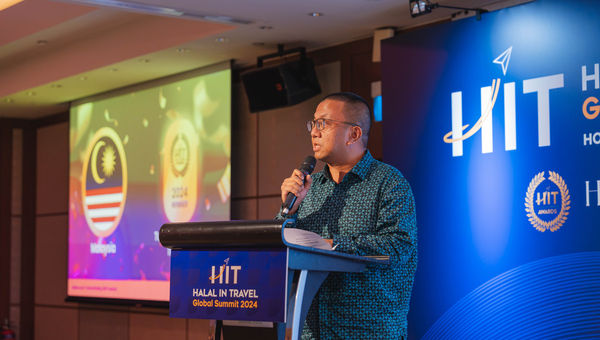
Nizran Noordin, director general of Malaysia’s Islamic Tourism Centre, speaking at the Halal In Travel Global Summit 2024.
Noordin also called for greater unity within the Muslim travel
industry, urging industry players to “put egos aside” and work on a more
comprehensive set of guidelines. “The Islam religion doesn’t belong to
anyone, but everyone seems to be coming out with their own set of
guidelines,” he said. “Let’s just have one common logo, one regulation
that we can all refer to, and market together to make the world more
inclusive.”
Meanwhile, Singapore has been named as the top non-OIC destination
for Muslim travellers for the ninth consecutive year, underscoring an
unwavering dedication to support Muslim travellers with a widespread
variety of halal food, prayer facilities, suitable airport amenities,
and Muslim-friendly accommodation.
The report also indicated strong interest in other Southeast Asian
destinations with Thailand and the Philippines ranking at #5 and #9 in
the top 10 non-OIC destinations respectively, indicative of increased
efforts to promote halal tourism and appeal to Muslim travellers.
CrescentRating founder and CEO Fazal Bahardeen said: “According to
research from the MasterCard Economics Institute, passenger traffic is
flying high and consumer spending on tourism remains robust; We’re
witnessing the current bounce back when it comes to the Muslim travel
market.
This shows, to me, the diversity and inclusivity when it comes to the
tourism landscape across the region. The rise of the Muslim traveller
is a significant opportunity for both tourism destinations and travel
operators.”
According to the GMTI, the Muslim travel market is set for a
significant uptick this year with global international arrivals
potentially reaching up to 168 million – exceeding pre-pandemic levels
by as much as 5%.
This growth in volume highlights the rising prominence of the
segment, driven by demographic and economic expansion, cultural and
Halal tourism development, and technological advancements that enable
more personalised travel experiences for Muslim travellers, such as apps
that locate Halal food outlets, Qibla directions, and prayer timings.
The impact of artificial intelligence is also helping further customise travel experiences to simplify travel logistics while adhering to faith traditions.
Safdar Khan, division president of Southeast Asia at MasterCard,
said: “Technology is helping this demographic travel in ways that meet
their unique needs, from AI-powered hyper-personalised experiences to
MasterCard’s own enablement of easy and secure cross-border payments.
Together, this heralds a new level of convenience for Muslim travellers
and unlocks a new era of growth and profitability for travel operators.”